

Regulated CFD brokers: how to verify a licence, with a checklist
Prepared by the Libertex team
Content reviewed internally in accordance with regulatory standards.
A regulated CFD broker is an investment firm authorised and supervised by a financial regulator. In the European Economic Area, that authorisation appears in a public register. MiFID II and the national product intervention measures on CFDs set the rules.
Regulation means authorisation plus supervision, and the EU rules cover registers, client funds, execution and leverage. Five verification steps, red flags, agreement clauses and a pre-funding checklist follow. Libertex is a Stock and CFD Broker.
Key takeaways
- Register check. A licence is confirmed in the regulator's public register, not on a broker's website.
- Entity match. The entity named in the client agreement must be the entity in the register.
- Limits, not outcomes. Regulation covers client funds, execution and leverage. ESMA's 2018 figures show 74-89% of retail CFD accounts losing money.
- Eight checks. The checklist covers the licence, the agreement, costs, the platform and withdrawals.
What does "regulated" mean for a CFD broker?
A regulated CFD broker is an investment firm authorised to offer contracts for difference and supervised by a financial regulator. A contract for difference is a derivative: it gives no ownership of the underlying asset.MiFID II requires every Member State to register all investment firms. The register is publicly accessible and updated regularly. Each entry lists the services the firm is authorised for.
An authorisation applies to one named legal entity and to a listed set of services. A licence held by one group company does not cover another company in the group. Firms outside the European Economic Area fall outside the EU measures on CFDs. Leverage limits and client protections there can differ.
Regulation sets conditions for firms and does not remove the risk of loss. National authorities' analyses, summarised by ESMA in 2018, found that 74-89% of retail accounts typically lose money on CFDs.
What EU rules require from a CFD broker
The rules in this table apply to firms authorised in the European Union. Each row states a rule of the named regulation, not a claim about any broker.
| Rule | What it requires | Source |
| Public register | All investment firms are registered; the public register lists their authorised services | MiFID II, Article 5(3) |
| Client assets | Adequate arrangements to safeguard clients' rights; client funds not used for the firm's own account | MiFID II, Article 16(8)-(9) |
| Order execution | All sufficient steps to obtain the most favourable result, on total cost for retail clients | MiFID II, Article 27(1) |
| Leverage limits | Retail leverage and margin capped from 30:1 for major currency pairs to 2:1 for CFDs on cryptocurrencies | ESMA / CySEC DI87-09 |
| Margin close-out | Positions closed at 50% of the minimum required margin, per account | ESMA / CySEC DI87-09 |
| Negative balance protection | An overall limit on retail client losses, per account | ESMA / CySEC DI87-09 |
| Investor Compensation | Eligible retail clients covered by statutory compensation schemes (e.g., CySEC Investor Compensation Fund up to €20,000) if a firm defaults | CySEC Directive DI87-07 / Directive 97/9/EC |
Source: MiFID II, Article 5(3), Article 16(8)-(9), Article 27(1), ESMA product intervention measures on CFDs, 27.03.2018 (15.10.2026)
ESMA's 2018 CFD measures were temporary. Permanent national measures mirroring them followed, restated by ESMA in February 2026.
Investor compensation schemes remain national, and cover depends on the firm's authorisation. ESMA notes that clients of unauthorised firms can lose compensation and ombudsman protections.
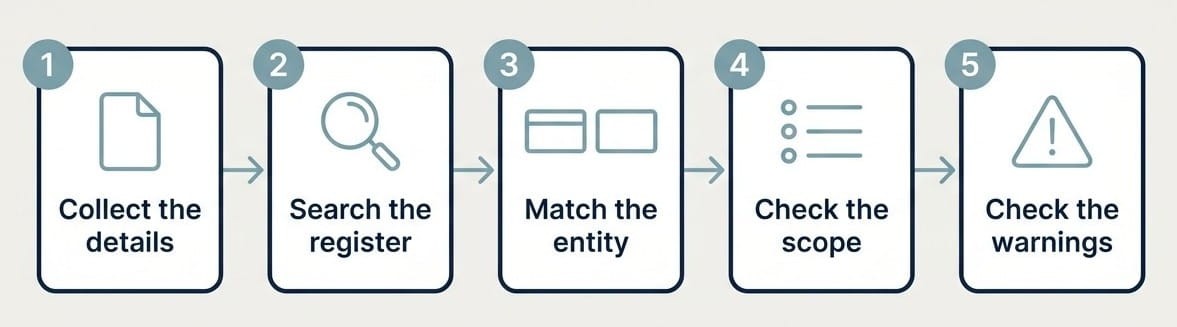
How to verify a CFD broker's licence in five steps
A CFD broker's licence is verified through a register search and the client agreement, not the broker's website. The ESMA register holds more than 5,800 entries with entity type Investment firm and status Active.
- Collect the details. Find the legal name, registration number, address and regulator in the website footer and the client agreement. Note which entity the client agreement is signed with.
- Search the register. Search the firm name in the national regulator's public register or in the ESMA register. ESMA's investor guidance sets out the check: entity type Investment firm, status Active. Swiss-licensed firms appear in FINMA's directory of authorised institutions instead. Open the register from the regulator's site, not a broker's page.
- Match the entity. The name, registration number and address must match the register entry. The entity in the client agreement must be the registered one.
- Check the scope. The register entry lists the authorised services, such as execution of orders and dealing on own account. Confirm that they cover the products offered.
- Check the warnings. Search the regulators' warning lists and I-SCAN, the alerts network of the International Organization of Securities Commissions. I-SCAN listed more than 47,000 member alerts on 15.10.2026.
Red flags of weak or fake regulation
One red flag alone does not prove a problem. Each one is a reason to stop and re-check the regulator's register.
- No licence number. The website names no legal entity, registration number or regulator.
- No register entry. The regulator's register shows no entry, or a status that is not active.
- Different entity. The client agreement names a company other than the registered one.
- Vague jurisdiction. The firm claims a licence "worldwide" without naming a regulator.
- Promises of fixed results. The marketing states a fixed outcome or describes trading without loss.
- Waived recourse. The agreement removes access to a regulator, an ombudsman or a court.
Each red flag points back to the register entry and the signed agreement, not the marketing.

What to read in the client agreement
The licence shows who the firm is. The client agreement shows how the firm treats clients.
- Close-out rule. The margin close-out triggers at 50% of the minimum required margin under EU measures. The broker's margin call level sits in the terms.
- Market-event clauses. Broad definitions of abnormal markets let a broker cancel, reprice or suspend trades.
- Requote and mistrade policy. The terms state when an order can be requoted or cancelled.
- Withdrawal conditions. The agreement sets out methods, processing times and fees.
- Governing law and complaints. The agreement names the contracting entity, the regulator or ombudsman and the complaint route.
A broker's refusal to explain a clause is information.
Checklist before funding an account
Eight checks turn the verification into a single pass. Public documents or customer support answer each one.
| Check | What to look for | Where |
| Authorisation | An active register entry under the firm's legal name | Regulator or ESMA register |
| Entity | The client agreement is signed with the registered entity | Client agreement |
| Authorised services | The register entry covers the products offered | Register entry |
| Client money | Confirm client funds are held in segregated accounts with reputable credit institutions and verify the firm's membership in a recognized statutory compensation scheme. | Client agreement |
| Leverage and close-out | Retail limits and the 50% close-out match the EU measures, and negative balance protection is stated | Terms |
| Costs | The full fee schedule: spread, commission, overnight financing, inactivity and withdrawal fees | Fee schedule |
| Platform | Tested on a demo account before funding, including MetaTrader 4 and MetaTrader 5 where offered. A demo account does not reproduce real market conditions or the psychological factors of trading with real money | Demo account |
| Withdrawals and support | Documented methods, processing times and fees, and a substantive answer from support; a first withdrawal request shows how the process works | Terms, support |
Conclusion
Verification costs only a register search: the licence, the entity and the authorised services. The client agreement and the eight checks cover what a licence cannot. MiFID II makes the register public and EU measures cap retail leverage.
Neither removes the risk. Contracts for difference are complex instruments and carry a high risk of losing money rapidly because of leverage. Before trading, a trader should fully understand how they work, the risks involved, and whether a partial or total loss of the invested capital is acceptable. Costs, platforms and execution models belong to how to compare CFD brokers, not the licence check.
Frequently asked questions
What is the difference between a regulated and an unregulated CFD broker?
A regulated CFD broker holds an authorisation from a financial regulator and appears in a public register. An unregulated firm does not appear there. ESMA notes that clients of unauthorised firms can lose protections such as investor compensation funds and financial ombudsmen.
How can a CFD broker's licence be verified?
A CFD broker's licence is verified in the national regulator's register or in the ESMA register. The entry shows the entity type, the status and the authorised services. The name, the registration number and the entity in the client agreement must match that entry.
Does regulation prevent losses on CFDs?
No. Regulation sets rules for firms, not outcomes for traders. National authorities' analyses summarised by ESMA in 2018 put the loss range for retail CFD accounts at 74-89%. Leverage limits and negative balance protection cap the size of losses without removing them.
What happens to client funds if a regulated broker fails?
Under MiFID II safeguarding rules, client funds are strictly segregated from firm own funds and cannot be accessed by general creditors. Additionally, retail clients of EU investment firms are covered by statutory investor compensation schemesWhat a client recovers depends on the insolvency proceedings and on the compensation scheme of the home regulator.
What do the ESMA leverage limits and the margin close-out mean for traders?
Retail leverage on CFDs runs from 30:1 for major currency pairs down to 2:1 for CFDs on cryptocurrencies under the EU measures. The margin close-out triggers at 50% of the minimum required margin, per account. A higher limit outside the EU is not a sign of stronger supervision.
What should traders check before funding a CFD account?
Traders check the licence and the contracting entity first, then the authorised services. The client agreement, the fee schedule, the platform on a demo account and the withdrawal terms follow. Eight checks cover the licence, the entity, the services, client money, leverage, costs, the platform and withdrawals.
Disclaimer: This article is provided for educational and informational purposes only. It does not constitute financial or investment advice, independent investment research or a recommendation by Libertex. Any examples, scenarios or forecasts are for illustrative purposes only and should not be relied upon as indicators of future performance. Past performance is not a reliable indicator of future results.
Why trade with Libertex?
- Get access to a free demo account free of charge.
- Enjoy technical support from an operator 5 days a week, from 9 a.m. to 9 p.m. (Central European Standard Time).
- Use a multiplier of up to 1:30 (for retail clients).
- Operate on a platform for any device: Libertex and MetaTrader.