

CFD brokers: how to choose one
Prepared by the Libertex team
Content reviewed internally in accordance with regulatory standards.
A CFD broker is a firm that gives clients access to contracts for difference (CFDs). The broker provides the trading platform and prices, executes orders and manages margin. The client does not own the underlying asset.
The sections below explain how CFD brokers work and make money, and which costs, leverage rules and regulations matter. A seven-step checklist then compares brokers point by point. Libertex is a Stock and CFD Broker.
Key takeaways
- Access: a CFD broker supplies the platform, prices, execution and margin for over-the-counter (OTC) CFDs.
- Authorisation: the first check is whether the regulator's public register lists the broker as authorised in your jurisdiction.
- Total cost: the full cost of a position is the spread plus commission, overnight financing and other account fees.
- Leverage: the European Securities and Markets Authority (ESMA) limits retail leverage and requires close-out at 50% of required margin.
- Testing: a demo account and the withdrawal process are checked before choosing.
What is a CFD broker?
A CFD broker is an investment firm that gives retail clients access to contracts for difference. In the wider sense, any firm or person executing trades in financial assets on behalf of clients is a financial broker. The CFD broker is one specialised type within that group.
Four things come from the CFD broker: the trading platform, a live price feed, order execution and margin tools. Each trade settles on the price difference between opening and closing a position. Ownership of the underlying asset, whether a share or a barrel of oil, never passes to the client.
Forex brokers and CFD brokers share mechanics but differ in market range:
- Forex broker: a forex broker mainly offers currency pairs.
- CFD broker: a CFD broker often adds CFDs on shares, indices, commodities, ETFs and cryptocurrencies.
- Shared mechanics: both broker types usually work with leverage, margin and overnight financing.
How CFD brokers make money
CFD brokers generate revenue from three main sources: the spread, commissions on some instruments and overnight financing. The spread is the difference between the bid and ask price, paid on every trade.
A commission is a separate per-trade charge that some brokers apply to certain instruments or account types. Overnight financing is charged or credited on leveraged positions held past the daily rollover time.
The mix of these charges differs by broker and account type. Exact rates for each instrument appear in the broker's fee schedule.
Market maker and ECN/STP brokers
Execution models differ in who takes the other side of a client's trade. A dealer trades on its own account, while a broker passes orders on. A market maker acts as a dealer.
- Market maker (dealing desk): the broker quotes prices and may act as counterparty, so its result can be the opposite of the client's. Conflict-of-interest and best execution rules address that conflict.
- ECN/STP: the broker routes orders to external liquidity providers, which can reduce the conflict of interest without removing it.
Both models fall under the Markets in Financial Instruments Directive II (MiFID II) best execution rule. Neither model means better execution in every market condition.
Advantages and disadvantages of CFD trading
CFDs are complex, leveraged instruments, and losses can build up rapidly. Before trading, a trader needs to understand how CFDs work and whether a partial or total loss of the invested capital is affordable.
National authorities' analyses cited by ESMA in 2018 found that 74-89% of retail accounts typically lost money on CFDs. CFD trading suits traders who understand leverage and accept the risk of loss.
The main advantages of CFD trading are:
- Leverage: a smaller deposit controls a larger exposure, which magnifies losses as well as gains.
- Two directions: a trader can open long positions on rising prices and short positions on falling prices.
- Several markets: one account can give access to CFDs on currencies, shares, indices and commodities.
- No ownership: a trader takes a view on the price without holding the underlying asset.
The main disadvantages of CFD trading are:
- Magnified losses: leverage increases losses in the same proportion as gains.
- Counterparty exposure: CFDs are OTC contracts, so the broker is the counterparty to every position.
- Financing costs: overnight financing builds up on positions held for days or weeks.
- Slippage and gaps: in fast markets, the execution price can differ from the requested price.
CFD trading costs
The advertised spread is only one part of what a CFD position costs. Total cost includes the spread, any commission, overnight financing and other account fees.
| Cost | What it is | Where to find it |
| Spread | Difference between the bid and ask price | Instrument specification or fee schedule |
| Commission | Fixed or percentage charge per trade on some instruments | Fee schedule |
| Overnight financing (swap) | Daily charge or credit on positions held past rollover | Instrument specification |
| Currency conversion fee | Charge when the instrument currency differs from the account currency | Fee schedule or client terms |
| Inactivity fee | Charge on an account with no trading for a set period | Client terms |
| Withdrawal fee | Charge on transferring funds out of the account | Payment terms or fee schedule |
Overnight financing applies when a position stays open past the daily rollover, usually around 5 pm. The rollover time varies by broker.
| Daily swap = position value × daily swap rate |
One day a week, a triple swap covers the weekend, on Wednesday or Friday depending on the broker. Some brokers also offer swap-free accounts.
Example calculation. A GBP/USD position of 10,000 units at 1.3000 has a position value of $13,000. A spread of 2 pips costs $2, because one pip equals $1 on 10,000 units.
A daily swap rate of 0.03% costs $3.90 per night, or $19.50 over 5 charged nights. Spread plus financing comes to $21.50 before any commission. The rates are illustrative and are not market data.
Leverage and margin
Leverage lets a trader control a larger exposure with a smaller margin deposit. At 10:1, $1,000 of margin controls a $10,000 position. Leverage and margin multiply gains and losses in the same proportion.
Margin is the deposit a broker holds against an open leveraged position. Required margin equals the position value divided by the leverage ratio. At 30:1, a $30,000 position needs $1,000 of margin.
ESMA sets the maximum leverage for retail clients by asset class. The limits apply when a retail client opens a position and vary with the volatility of the underlying asset. The limit for a position therefore depends on the instrument. Actual trading conditions also depend on the jurisdiction, client category, account type and the broker's legal entity.
| Asset class | Maximum leverage for retail clients |
| Major currency pairs | 30:1 |
| Non-major currency pairs, gold and major indices | 20:1 |
| Commodities other than gold and non-major equity indices | 10:1 |
| Individual equities and other reference values | 5:1 |
| Cryptocurrencies | 2:1 |
Source: ESMA
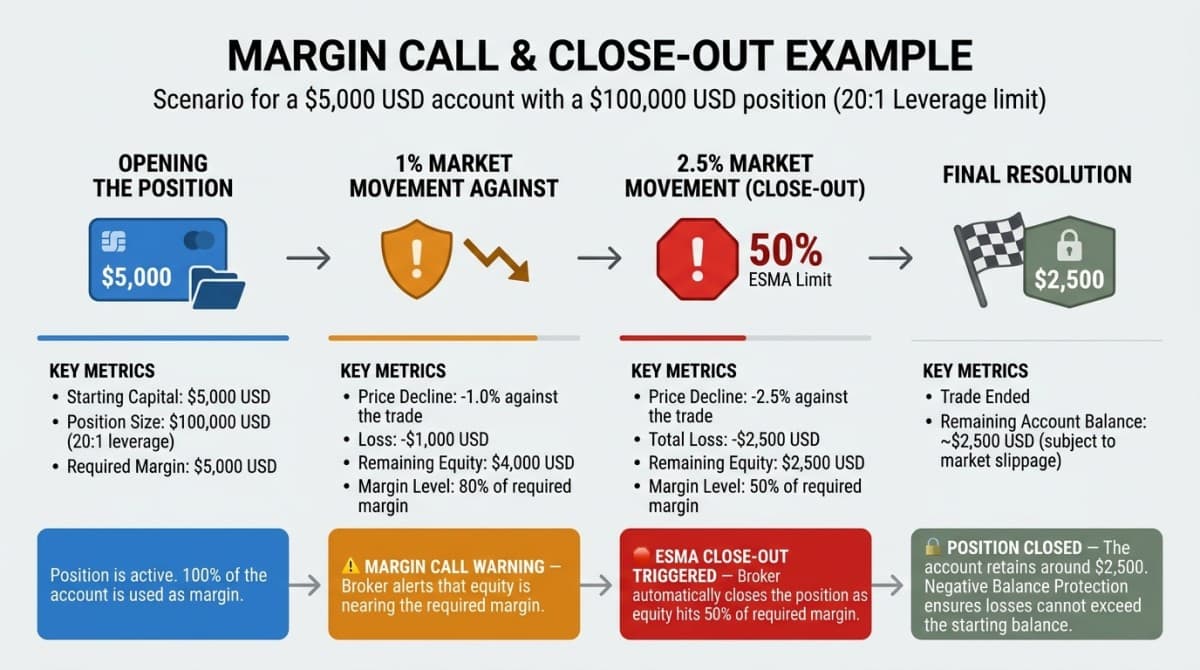
How a margin call and close-out work: an example
A margin call warns that equity is nearing the required margin; close-out ends the position. Example calculation:
- A trader has $5,000 and opens a $100,000 position on an instrument limited to 20:1. The required margin is $5,000, the whole balance.
- The price moves 1% against the position. The loss is $1,000, equity falls to $4,000, and the margin level is 80%. Each broker sets its own margin call warning level.
- The price moves 2.5% against the position. The loss is $2,500 and equity is $2,500, which is 50% of the required margin. The broker closes the position under the ESMA close-out rule.
- The account keeps about $2,500 before slippage. In fast markets the closing price can differ; negative balance protection limits retail losses to the account balance.
 :
Regulation: what to check
Regulation decides which rules a CFD broker must follow. ESMA adopted its CFD measures under Article 40 of the Markets in Financial Instruments Regulation (MiFIR) in 2018. For firms authorised in the EU, those rules include MiFID II best execution, client-asset arrangements and the ESMA measures on leverage, close-out and negative balance protection.
Under MiFID II Article 16, a firm holding client funds must make adequate arrangements to safeguard clients' rights. The same article bars the firm from using client funds for its own account, with an exception for credit institutions.
Brokers authorised outside the European Economic Area (EEA) are not bound by the ESMA measures. Leverage limits and client protections at such brokers can differ.
How to verify a broker's licence
An authorisation check takes four steps and uses only public information from the broker and the regulator:
- Find the broker's legal name and authorisation or registration number on its website.
- Search the national competent authority's public register, such as the Cyprus Securities and Exchange Commission (CySEC) register for a Cyprus firm.
- Confirm that the firm is authorised, with an active status, to provide the services offered, such as CFDs, in your jurisdiction.
- Check which legal entity the client agreement is signed with.

Trading platforms
The trading platform decides how a trader places orders, reads charts and manages open positions. Platform choice depends on trading style, so the platform is worth checking before choosing a broker.
The Libertex platform is available as a mobile app for iOS and Android, uses market execution and lists 1,000+ trading instruments. MetaTrader 4 is a trading platform that Libertex offers alongside its own platform. Libertex also offers MetaTrader 5, the newer version of MetaTrader.
Other brokers may offer other platforms. A demo account shows how order entry, charts and risk management tools work on each platform. A demo does not fully reproduce real market conditions or the psychological side of trading with real money.
Matching a broker to your trading style
No single broker suits every trading style. Each style puts weight on a different cost or execution feature.
| Trading style | What usually matters | What to check |
| Scalper | Speed and spread | Execution quality and slippage |
| Day trader | Spread and platform stability | Spreads on target instruments, platform behaviour in busy sessions |
| Swing trader | Overnight financing | Swap rates on held instruments |
| Position trader | Financing over weeks, instrument range | Swap rates, triple-swap day, available instruments |
| News trader | Execution in volatile markets | Slippage and price gaps around data releases |
A scalper pays the spread on every one of many daily trades. Overnight financing, in contrast, hits a swing trader on every night a position stays open. The same broker can therefore cost each style a different amount.
A 7-step checklist for choosing a CFD broker
A seven-step check covers authorisation, costs, platform, instruments, payments and support. Each step lists the action and a common mistake.
- Verify the authorisation. Check in the national regulator's public register that the firm is authorised to provide services in your jurisdiction. A common mistake is trusting an authorisation claim on the website without checking the register.
- Match the broker to the trading style. Compare spreads, swap rates and execution with the way you plan to trade. A common mistake is comparing brokers on features the chosen style does not use.
- Read the full cost schedule. Add up spread, commission, overnight financing and account fees for a typical position. A common mistake is choosing by the advertised spread alone.
- Test the platform on a demo account. A demo account shows order types, charts and margin display with virtual funds, although it does not fully reproduce live market conditions. A common mistake is skipping the demo and learning the platform with real money.
- Check instruments and leverage limits. Confirm that the instruments you plan to trade are offered, and note the leverage limit for each. A common mistake is using more leverage than the account size supports.
- Check deposits and withdrawals. Review payment methods, processing times, fees and the withdrawal steps themselves. A common mistake is checking the withdrawal process only after depositing.
- Check support. Note the support channels, languages and hours. A common mistake is discovering support limits during an urgent account issue.
Conclusion
Choosing a CFD broker is a process, not a one-time decision. Authorisation status, the fee schedule and the platform are worth re-checking at least once a year, or when trading goals change.
ESMA leverage limits and the MiFID II execution and client-asset rules set the baseline for brokers authorised in the EU. A short FAQ entry explains what a CFD broker is.
Frequently asked questions
What is a CFD broker?
A CFD broker is a firm that provides access to contracts for difference: the trading platform, prices, order execution and margin. The client trades on price movements without owning the underlying asset. CFDs are OTC contracts, so the broker is the client's counterparty.
How do CFD brokers make money?
CFD brokers make money mainly through the spread, commissions on some instruments and overnight financing on leveraged positions. The mix differs by broker and account type. The exact rates for each instrument appear in the broker's fee schedule or instrument specification.
What is the difference between a CFD broker and a forex broker?
A forex broker focuses on currency pairs, while a CFD broker offers CFDs on several asset classes. Those classes often include shares, indices, commodities and currencies. ESMA retail limits allow up to30:1 on major currency pairs and 5:1 on individual equities.
Do CFD brokers trade against their clients?
The answer depends on the execution model. A market maker can take the other side of a client's trade, which creates a conflict of interest. An ECN/STP broker routes orders to external liquidity providers. Under MiFID II Article 27, both must seek the best possible result for clients.
Is CFD trading risky, and what share of traders lose money?
Yes, CFDs are leveraged, and losses can build up quickly. National authorities' analyses cited by ESMA in 2018 found that 74-89% of retail accounts typically lost money. Average losses per client ranged from €1,600 to €29,000. A separate FAQ page explains the main risks of CFD trading.
What EU rules apply to client money at a CFD broker?
MiFID II requires firms holding client funds to make adequate arrangements to safeguard clients' rights. The same rule bars firms, except credit institutions, from using client funds for their own account. The ESMA measures add negative balance protection for retail clients on a per-account basis.
How does leverage work in CFD trading?
A margin deposit controls a larger exposure: at 10:1, $1,000 controls a $10,000 position. ESMA limits retail leverage by asset class, from 30:1 for major currency pairs to 2:1 for cryptocurrencies. Gains and losses grow in the same proportion, and actual leverage depends on the jurisdiction and account type.
Can I practise CFD trading on a demo account?
Yes, a demo account lets a trader test the platform and order types with virtual funds. Demo results do not include real-market effects such as slippage, nor the psychological factors of trading real money. A demo shows how a platform works, not how real orders are filled.
Disclaimer: This article is provided for educational and informational purposes only. It does not constitute financial or investment advice, independent investment research or a recommendation by Libertex. Any examples, scenarios or forecasts are for illustrative purposes only and should not be relied upon as indicators of future performance. Past performance is not a reliable indicator of future results.
Why trade with Libertex?
- Get access to a free demo account free of charge.
- Enjoy technical support from an operator 5 days a week, from 9 a.m. to 9 p.m. (Central European Standard Time).
- Use a multiplier of up to 1:30 (for retail clients).
- Operate on a platform for any device: Libertex and MetaTrader.