

CFD trading explained: key concepts and risks
Prepared by the Libertex team
Content reviewed internally in accordance with regulatory standards.
CFD trading is speculation on the price change of an asset through a contract for difference. The result is the difference between the opening and the closing price, settled in cash, without ownership of the asset. Leverage magnifies that result in both directions.
The sections below cover long and short positions, leverage and margin, and the three cost items. One worked example and the main risks of CFD trading follow. Each concept is defined once, in its own section. Libertex is a Stock and CFD Broker.
Key takeaways
- A CFD is a cash-settled derivative on a price difference, with no ownership of the asset.
- Long positions gain when the price rises, short positions when it falls, and both can lose.
- Leverage applies gains and losses to the full position value; CySEC caps retail leverage from 30:1 to 2:1.
- ESMA reported on 27.03.2018 that 74-89% of retail CFD accounts typically lost money.
How CFD trading works
Contracts for difference are derivative contracts between a trader and a CFD provider. The difference between opening and closing price settles in cash. The contract lets a trader speculate on a share price without owning the asset.
CFD positions are traded over the counter, not on a trading venue, as ESMA records. The provider acts as direct counterparty to the client's trade. A futures contract is standardised and exchange-traded with an expiry date; a spot CFD has none.
Underlying assets include the currency pair EUR/USD, the FTSE 100 and S&P 500 indices, Apple and Tesla shares, and gold.
Going long and going short
- Long position: opened on an expected price rise; gains when the price rises, loses when it falls.
- Short position: opened on an expected price fall; gains when the price falls, loses when it rises.
Long result: (exit price - entry price) × quantity; short: (entry price - exit price) × quantity. Example calculation: 15 shares at $200.00 fall to $190.00. The long shows -$150.00, the short +$150.00, before costs.
Unlike short selling, a short CFD position needs no ownership or borrowing: the contract settles the price difference. A short position can also hedge a falling share portfolio, though the offset is imperfect and holding costs apply.
Leverage and margin
Leverage and margin are one ratio: leverage is position value divided by margin. Margin is that value divided by leverage.
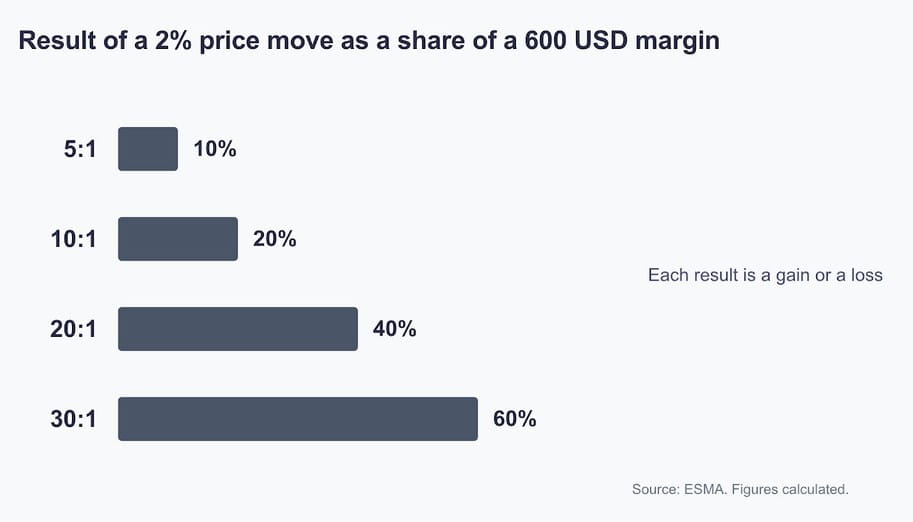
Example calculation: $600 of margin at 10:1 supports a $6,000 position. A 1% move on the full $6,000 is $60, 10% of the margin. Leverage magnifies gains and losses alike, and is one of the main risks of CFD trading.
CySEC applies retail CFD leverage caps from 30:1 to 2:1, following the 2018 ESMA framework.
| Leverage | Retail leverage limit | Margin, USD | Position size, USD | Result of a 2% price move, USD | As % of margin |
| 5:1 | Individual equities and other reference values | 600 | 3,000 | +60 or -60 | 10% |
| 10:1 | Other commodities, non-major equity indices | 600 | 6,000 | +120 or -120 | 20% |
| 20:1 | Non-major pairs, gold, major equity indices | 600 | 12,000 | +240 or -240 | 40% |
| 30:1 | Major currency pairs | 600 | 18,000 | +360 or -360 | 60% |
Source: Source: CySEC Policy Statement PS-04-2019 (27.09.2019), which follows the 2018 ESMA framework; ESMA’s own measures expired on 31.07.2019. Figures calculated for a fixed margin of $600 and a 2% price move; spread, commission and financing are not included. Cryptocurrency CFDs: 2:1, margin 50%.
A margin call warns at a level the provider sets. CySEC sets the close-out rule. Positions close automatically when account funds plus unrealised profits fall below 50% of the required margin.
Negative balance protection is a CySEC rule capping a retail client’s total loss at account funds, per account.
What CFD trading costs
Three cost items reduce the result of every CFD position: spread, commission and overnight financing.
- Spread: the difference between the bid price and the ask price. A position opens at the ask price and closes at the bid, paying the spread at entry. Thin market liquidity or fast moves widen it.
- Commission: charged per trade on some instruments, commonly share CFDs. Index and currency CFDs are priced through the spread. Practice differs by provider and account type; a 0.1% rate is illustrative, not a Libertex rate.
- Overnight financing: charged or credited when a position stays open past the cut-off. The charge per night is position value × (benchmark rate ± provider markup) ÷ 360, or 365 for some instruments. SOFR from the Federal Reserve Bank of New York is the common benchmark for US dollar positions. Example calculation: $3,000 × 6% ÷ 360 = $0.50 per night, growing each night.
CFD trade example: from entry to net result
Example calculation. The worked example uses one long position on an Apple share CFD. The figures are hypothetical, not current quotes and not Libertex prices. Five more worked cases appear on the CFD trading example page.
- Asset and direction: a long position on an Apple share CFD at $200.00, the ask price.
- Position size: 15 shares, position value $3,000, margin $600 at the 5:1 ESMA equity limit.
- Opening: the position opens in MetaTrader 4 or MetaTrader 5, available on the Libertex platform. Commission is 0.1%, or $3.00, and the spread sits inside the quoted prices.
- Holding: overnight financing of $0.50 per night, with a stop-loss order set at $194.00.
- Closing: the position closes and Table 2 gives the net result.
| Step (USD) | Winning exit | Losing exit |
| Entry (ask price) | 200.00 | 200.00 |
| Position value | 15 × 200.00 = 3,000 | 15 × 200.00 = 3,000 |
| Margin (5:1) | 3,000 ÷ 5 = 600 | 3,000 ÷ 5 = 600 |
| Exit | 212.00 (bid price) after 3 nights | Stop-loss order at 194.00 after 1 night |
| Gross result | (212.00 - 200.00) × 15 = +180.00 | (194.00 - 200.00) × 15 = -90.00 |
| Commission, 0.1% per side | 3.00 + 3.18 = 6.18 | 3.00 + 2.91 = 5.91 |
| Overnight financing | 3,000 × 6% ÷ 360 = 0.50 per night; 3 nights = 1.50 | 0.50 for 1 night |
| Net result | 180.00 - 6.18 - 1.50 = +172.32 | -90.00 - 5.91 - 0.50 = -96.41 |
Example calculation. All figures are hypothetical. The share price, the commission rate of 0.1% and the financing rate of 6% are illustrations. The 6% rate is all-in, benchmark plus provider markup. None are Libertex prices or rates. The quoted entry and exit prices already include the spread.
Takeaways from the worked example
- Leverage: a 3% price fall cost $90.00, 15% of the $600 margin, in line with 5:1.
- Costs: commission and financing turned $ 180.00 gross into $ 172.32 net, and -$ 90.00 into -$ 96.41.
- Break-even: the price must reach about $200.40, or $0.40 per share, to cover round-trip commission. Each night adds $0.50.

Key risks of CFD trading
The risks of CFD trading follow from the same mechanics. Leverage applies price moves to the full position value, so a loss can take the margin. Total loss of the capital in a CFD account is possible. The other risks come from the over-the-counter structure, market conditions and holding costs.
| Risk | How it arises | What applies |
| Leverage | Gains and losses are calculated on the full position value, not on the margin | Retail limits of 30:1 to 2:1 by asset class under CySEC measures (PS-04-2019), following the 2018 ESMA framework |
| Margin close-out | Equity falls toward the required margin as the price moves against the position | Positions are closed at 50% of the total initial margin (CySEC, PS-04-2019) |
| Volatility and gaps | A fast price move or a gap can use up the margin before an order is filled | Negative balance protection limits a retail client's total loss to the account funds |
| Counterparty (over-the-counter) | The CFD is a contract with the provider and is not cleared through an exchange | The provider's contract terms and the rules of its supervisory authority apply |
| Liquidity and slippage | In thin or fast markets the spread widens and an order can fill away from the quoted price | A standard stop-loss order closes at the next available price, which can differ from the set level |
| Holding costs | Overnight financing is charged on the full position value for every night a position stays open | The amount depends on the benchmark rate and the provider markup |
Sources: CySEC Policy Statement PS-04-2019 (27.09.2019); ESMA (27.03.2018), measures expired 31.07.2019.
Regulatory risk facts
- ESMA reported on 27.03.2018 that national authorities found 74-89% of retail CFD accounts typically lost money.
- ESMA's 27.03.2018 measures required each provider to state its own share of losing retail accounts over 12 months. The percentage is recalculated quarterly.
- FCA PS19/18 sets UK leverage caps of 30:1 to 2:1, 50% close-out and negative balance protection. UK rules took effect on 01.08.2019.
Stop-loss orders can limit a loss at a chosen level. A standard stop-loss order executes at the next available price, so slippage is possible in fast markets. Margin rules, cost models and execution quality differ by provider, account type and jurisdiction. Those differences are the starting point for how to compare CFD brokers.
Conclusion
The result of a CFD position is the price move on the full position value. Spread, commission and financing reduce that result. Leverage decides how large the effect is in both directions.
CySEC applies retail limits of 30:1 to 2:1, the 50% close-out and negative balance protection. The measures follow the framework ESMA set on 27.03.2018.
Prepared by the Libertex team. Content reviewed internally in accordance with regulatory standards.
Frequently asked questions
What are the main risks of CFD trading?
The main risks are leverage, margin close-out, counterparty risk, slippage and overnight holding costs. Leverage applies losses to the full position value, not to the margin. Margin close-out then closes positions at 50% of the minimum required margin. In fast markets a stop-loss order can fill away from the set level.
What percentage of retail traders lose money on CFDs?
ESMA reported on 27.03.2018 that 74-89% of retail CFD accounts typically lost money. The figure comes from analyses by national competent authorities across EU jurisdictions. Each CFD provider must also state its own percentage for the previous 12 months, recalculated quarterly.
Can a trader lose more than the deposit on a CFD?
No, not as a retail client of a provider authorised in the EEA, where negative balance protection applies. CySEC applies that rule under PS-04-2019. Protection applies per account, not per position, and caps the loss at the funds in the CFD account. The loss can still equal the whole account balance.
Does a trader own the asset behind a CFD?
No. A CFD is a cash-settled contract on a price difference, so the trader holds no shares, currency or commodity. A spot CFD has no fixed expiry date, while a futures contract expires on a set date. Settlement is in cash in both directions.
How is overnight financing calculated on a CFD?
Overnight financing per night equals position value × (benchmark rate ± provider markup) ÷ 360. Some instruments use 365. SOFR is the common benchmark for US dollar positions, and models vary by provider. Example calculation: $3,000 × 6% ÷ 360 = $0.50.
Disclaimer: This article is provided for educational and informational purposes only. It does not constitute financial or investment advice, independent investment research or a recommendation by Libertex. Any examples, scenarios or forecasts are for illustrative purposes only and should not be relied upon as indicators of future performance. Past performance is not a reliable indicator of future results.
Why trade with Libertex?
- Get access to a free demo account free of charge.
- Enjoy technical support from an operator 5 days a week, from 9 a.m. to 9 p.m. (Central European Standard Time).
- Use a multiplier of up to 1:30 (for retail clients).
- Operate on a platform for any device: Libertex and MetaTrader.